
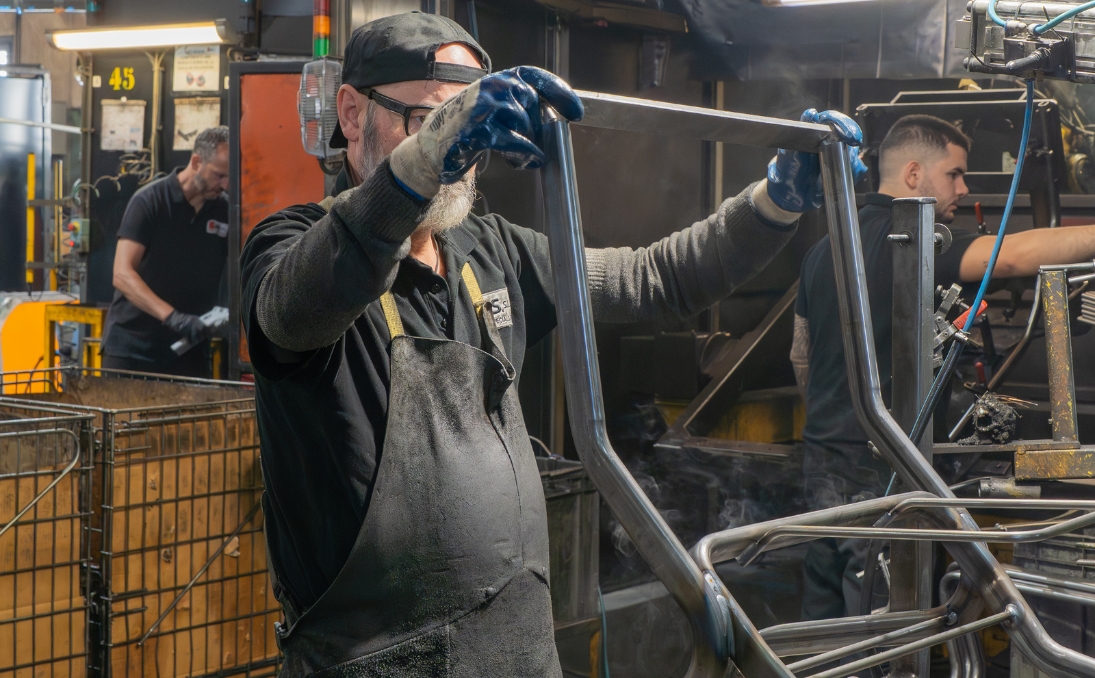
The image shows a specialized operator handling a newly welded tubular frame in an industrial production environment. This is the type of work we do every day at CORVATS ESPECIALS SL (COES): industrial welding of metal sub-assemblies with a focus on efficiency, strength and quality control.
For many industries, outsourcing the fabrication and welding of subassemblies is the most direct way to reduce assembly times, ensure the repeatability of parts and gain capacity without expanding facilities. From our plant in Terrassa (Barcelona) we work with national and international manufacturers, engineering companies and distributors who need a reliable partner for their metal projects.
What is industrial welding of metal subassemblies?
We talk about industrial welding of metal sub-assemblies when, in addition to joining parts, we deliver tubular or structural assemblies ready to be integrated into the customer's assembly line. This includes frames, chassis, supports, frames, piping and any structure formed by tubes and metallic components previously bent, shaped or machined.
At COES we combine processes of cold tube bending, tube forming y tube welding to supply complete subassemblies. This simplifies the customer's supply chain: instead of managing multiple references and internal operations, they receive finished assemblies with the required geometry and specifications.
Industrial welding of metal subassemblies for efficiency gains
Supply chain integration
When the welding of subassemblies is integrated from the design stage, it is possible to group operations that would otherwise be performed in different phases. Bending the pipe, shaping the pipe ends, adding sockets, nuts, plates or supports and welding all in a single flow reduces downtime and material movements.
For the customer, this means fewer references to manage, fewer internal operations and faster final assembly. Our sub-assemblies arrive labeled and packaged according to your needs, ready to enter the production line or logistics.
Reduced assembly time and costs
By receiving welded metal subassemblies, final assembly becomes a rapid assembly operation. In-plant adjustments are minimized, the risk of errors is reduced and the time to launch new products is shortened. This is especially critical in sectors that work with medium and high series or Just in Time programs.
Strength and reliability in every welded joint
Selection of the appropriate welding process
The choice of welding process is key to guarantee the strength of the sub-assembly. Depending on the material, thickness and project requirements, we apply MIG/MAG, TIG or robotic welding processes when large series with high seam repeatability are required.
Our goal is to achieve an optimum balance between mechanical strength, bead appearance and productivity. That is why we analyze together with the customer requirements such as loads, duty cycles, service environment and possible post-treatments such as coatings or painting.
Typical materials and thicknesses
We work with carbon steels, stainless steels and aluminum, covering a wide range of diameters and tube thicknesses. Flexibility in materials and sections allows us to manufacture subassemblies ranging from light structures to robust frames under continuous load.
Quality control and verification of subassemblies in COES
Dimensional control and finishing
Each welded sub-assembly undergoes dimensional checks adapted to the part geometry: gauges, templates, checking fixtures or checks on welding tools. In this way, we ensure that the parts assemble correctly on the customer's line, avoiding rework and deviations.
When the project requires it, we can complement these controls with non-destructive testing or specific verifications agreed with the customer. The result is clear traceability on batches, manufacturing dates and operations performed, which is key in demanding sectors.
Prototypes, pre-series and long series
COES is specialized in the manufacture of large series, however, once the project is awarded, we actively participate in it, making the necessary prototypes and pre-series, to validate both the product and the production process.
When does it make sense to outsource subassembly welding?
Outsourcing the welding of metal subassemblies provides value in many situations:
- When the customer's plant is at capacity limit and needs to increase production without investing in new lines.
- When the geometrical complexity of the subassemblies requires specific tooling and experience in tube bending and welding.
- When seeking to reduce industrialization times of new products and shorten time-to-market.
- When you want to simplify supplier management by delegating bending, forming and welding to a single specialized partner.
In these cases, having an ally like COES allows you to focus on design, final assembly and the relationship with the market, delegating the manufacture of metal subassemblies to an expert team. If you already work with tubular assemblies and want to review their design to gain efficiency, we can support you in improving manufacturability.
From Terrassa (Barcelona) we serve companies all over Spain and different international markets, always with a focus on technical precision, customized solutions and flexibility in materials and diameters.
Do you want to evaluate the outsourcing of your welded metal sub-assemblies? Check out our services of tube welding, of cold tube bending and of tube forming, or learn more about our company in the section about COES. And if you already have a project underway, you can write to us directly from the page of contact.
Frequently asked questions about welding of metal subassemblies
What are the advantages of receiving welded subassemblies versus single parts?
Receiving welded metal subassemblies reduces the number of references the customer must manage and simplifies final assembly. Instead of coordinating bending, machining, forming and welding at different suppliers or in-house processes, everything is centralized in a single partner. This shortens lead times, reduces the risk of errors and facilitates the introduction of productivity-oriented design improvements. It also saves space on the shop floor and frees up resources for higher value-added tasks.
What types of materials can be combined in a welded subassembly?
Most commonly, carbon steels, stainless steels and aluminum are used, whether in round, square, rectangular or special shapes. The choice of material depends on the working environment, mechanical loads, corrosion requirements and subsequent finishes. At COES we analyze each project to recommend the most suitable solution, both in terms of material, thickness and type of joint. The objective is to achieve a resistant structure, stable over time and economically competitive.
How is the weld quality of the subassemblies controlled?
Quality is controlled from tooling design to final verification. We use fixtures and gauges that guarantee geometry repeatability, and key dimensions are checked before each batch is released. When the project requires it, non-destructive testing or additional controls are applied in agreement with the customer. All this information is recorded to ensure the traceability of the parts and to be able to replicate the manufacturing conditions over time.
Is it feasible to outsource only a part of my metal sub-assemblies?
Yes, many companies start by outsourcing the more complex or time-consuming welding references and keep simple sub-assemblies in-house. Over time, and once the time and cost benefits have been proven, the scope is usually expanded. At COES we adapt to this progressive approach, helping to identify which subassemblies generate more value when outsourced and how to integrate them into the customer's logistics and planning.
How can I request a study for my tubular subassemblies?
The first step is to share drawings, 3D models or physical samples of the actual subassemblies, along with estimated volumes and quality requirements. From there, we analyze the feasibility of fabrication combining bending, forming and welding, and propose the most suitable solution. If you would like to start this process, you can contact our team through the COES contact; We will be happy to study your case.
 Español
  English
  Català