
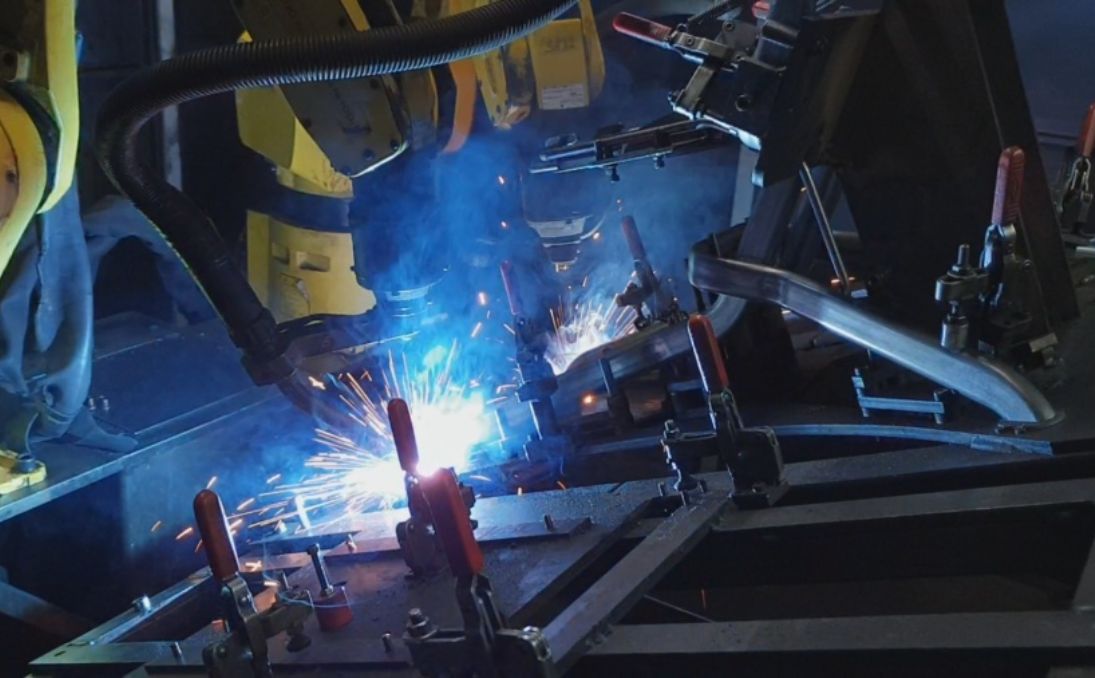
The image shows a robotic welding process in an industrial environment, where an automated arm executes a weld bead with high precision on a metal assembly. Manual vs. robotic welding: This type of technology coexists today with manual welding in many industrial projects, and making the right choice between the two is key to ensuring quality, efficiency and profitability.
Key differences between manual and robot welding
Manual and robotic welding meet different production needs. Understanding their technical and operational differences is the first step in making the right decision according to the type of project.
Human intervention vs. automation
In manual welding, the operator directly controls the process, adapting to small variations in real time. In robotic welding, the process is programmed and executed by an automatic system, reducing dependence on the human factor.
Accuracy and repeatability
Robotic welding stands out for its high repeatability, especially in long series. Manual welding, if well executed, offers high quality, but may present slight variations between parts.
When to choose manual welding in industrial projects
Manual welding remains an indispensable solution in many industrial contexts, especially when the project requires flexibility or specialized technical intervention.
Short series and customized parts
For prototypes, small series or single parts, manual welding allows rapid adaptation without the need for complex programming.
Complex geometries or difficult access
When parts have irregular shapes or areas that are difficult to access, the welder's experience is crucial to ensure a correct finish.
Advantages of robotic welding in series production
Robotic welding is especially efficient in repetitive production environments, where standardization brings important competitive advantages.
Productivity and process control
Robotic systems make it possible to work at constant rates, reduce cycle times and maintain stable parameters, which translates into higher productivity.
Consistent quality and error reduction
By eliminating human variation, consistent quality is obtained in all weld seams, minimizing rework.
Technical factors in deciding the type of welding
Beyond production volume, there are technical factors that directly influence the choice between manual or robotic welding.
- Type of pipe material and thickness
- Finish requirements and tolerances
- Annual production volume
- Integration with bending or forming processes
In projects where the tube bending and welding are part of the same assembly, joint planning of the process is essential.
Hybrid approach: combining manual and robot welding
In many industrial projects, the best solution is not to choose a single technique, but to combine both techniques depending on the production phase.
At COES it is common to integrate robotic welding for long series and to use manual welding for final adjustments, prototypes or special parts, thus optimizing costs and lead times.
Industrial welding at COES: advice for your project
At CORVATS ESPECIALS SL (COES), with more than 40 years of experience in the industrial and metallurgical sector, we analyze each project individually to recommend the most efficient solution.
Our service of tube welding is integrated with forming and bending processes, offering customized solutions for national and international customers.
Do you have a project underway? Contact our technical team and we will advise you without obligation.
Frequently asked questions about manual and robotic welding
Is robotic welding always more expensive?
Not necessarily. Although the initial investment is higher, in long production runs the cost per part is usually lower thanks to productivity and error reduction.
Does manual welding offer a better finish?
It depends on the project. An experienced welder can achieve excellent finishes, but robotic welding guarantees constant uniformity in large series.
Can bent pipes be welded with robotic systems?
Yes, as long as the design and programming allow it. In many cases, pre-bending is combined with specific robotic welding.
Which option is better for international projects?
For large volumes destined for international markets, robotic welding is often the most efficient option due to its control and repeatability.


 Español
  English
  Català