
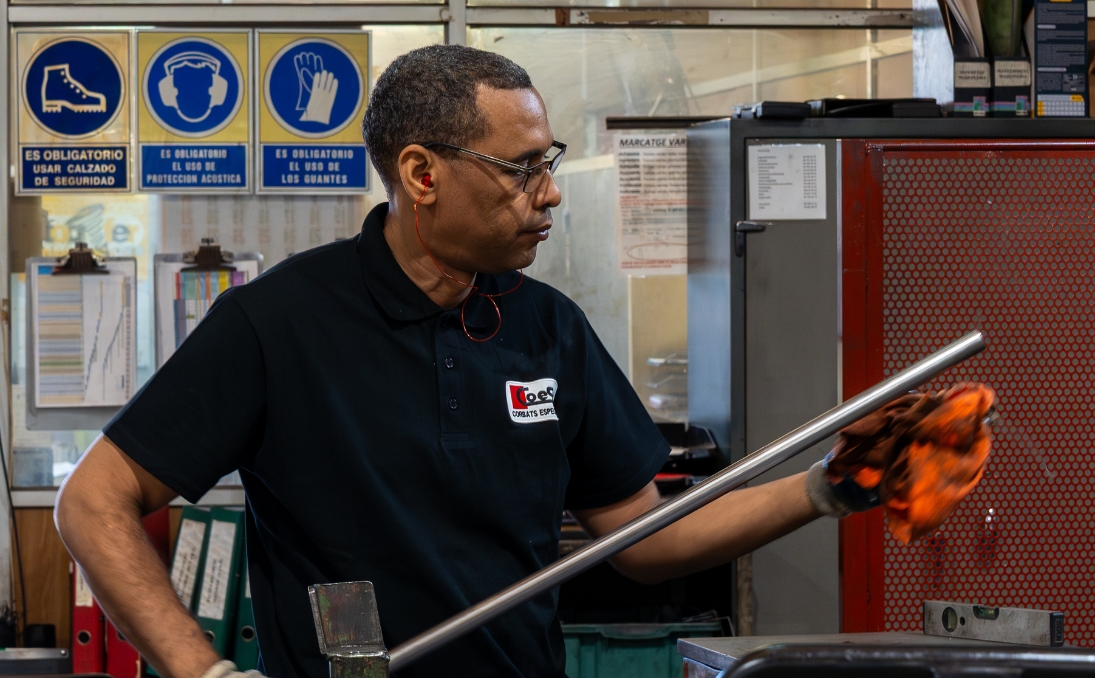
The picture shows a skilled operator working with an industrial bending machine, manually adjusting a metal tube in a real production environment. This type of operation reflects the importance of correctly defining the bending radius from the initial stages of any industrial project.
Choosing the right bending radius is a key technical decision that directly influences the functionality, mechanical strength and production feasibility of a part. In industrial and metallurgical sectors, a poorly defined radius can lead to deformations, section losses or even structural failures. In this article we explain how to determine the optimum bending radius according to your application, materials and technical requirements.
What is the bending radius and why is it critical in the industry?
The bending radius is the distance measured from the imaginary center of the arch to the central axis of the bent tube. This parameter determines the severity of the bend and conditions the behavior of the material during the forming process.
In industrial applications, the bending radius directly affects the final geometry, mechanical strength, process repeatability and compatibility with other components. Therefore, its definition must be approached from a technical and production perspective.
Relationship between bending radius, tube diameter and tube thickness
Tube outside diameter
The larger the tube diameter, the larger the bending radius should be to avoid ovalization or kinks. As a general rule, very tight radii in large diameter pipes increase the risk of defects.
Wall thickness
Thickness directly influences the tube's ability to withstand deformation. Thin-walled tubes require wider radii, while thicker thicknesses allow tighter radii without compromising structural integrity.
D/R ratio (diameter/radius)
In industrial engineering, the ratio between tube diameter and bending radius is used as a reference to define the technical feasibility of the process. A balanced ratio guarantees dimensional stability and surface quality.
Influence of the material on the choice of the bending radius
Not all materials respond equally to bending. The mechanical behavior of the metal is decisive in establishing the minimum allowable radius.
- Carbon steel: good deformation capacity, it admits medium and closed radii according to thickness.
- Stainless steel: greater elasticity and return, it usually requires somewhat wider radii.
- Aluminum: ductile material but sensitive to marking and collapse if the radius is too small.
- Special tubes or alloys: require prior analysis and specific tests.
In complex industrial projects, having a supplier with expertise in tube bending allows the radius to be adapted to the material without compromising functionality.
Functional requirements and project tolerances
Available space and overall design
In many projects, the bending radius is conditioned by the assembly space or by the integration of the tube into a larger assembly. In these cases, it is essential to balance design and production feasibility.
Mechanical stresses and work load
A radius that is too tight can generate stress concentrations. In applications subject to vibration, pressure or thermal cycling, a larger radius improves component durability.
Dimensional tolerances
The tighter the tolerances, the more important it is to define a stable and repeatable bending radius. This is influenced by both the machinery and the experience of the operator.
Cold bending and its technical limits
Cold tube bending is the most widely used method in the industry due to its precision and efficiency. However, it has technical limits that must be considered when defining the radius.
A radius that is too small can cause:
- Tube crushing
- Wrinkles on the inner side
- Excessive ovalization
- Uncontrolled elastic return
At COES, with more than 40 years of experience in Terrassa (Barcelona), each project is evaluated to ensure that the defined radius is technically feasible within the processes of tube forming and subsequent operations.
When to consult an industrial bending specialist
Defining the bending radius should not be an isolated decision. Having specialized technical advice helps to optimize costs, reduce iterations and guarantee final quality.
It is advisable to consult a specialist when:
- The required radius is very tight with respect to the diameter
- The material is critical or unusual
- The project requires high tolerances
- The tube can be integrated into welded or machined assemblies.
If your project requires a customized solution, you can learn more about our experience in the section of company or ask for direct advice.
FAQs on bending radius in industrial projects
Is there a standard minimum bending radius?
There is no single value valid for all cases. The minimum radius depends on diameter, thickness, material and bending process. It must therefore always be evaluated on an individual basis.
Is a larger radius always better?
Not necessarily. A larger radius reduces stresses, but may not fit the design or increase costs. The balance between functionality and feasibility is key.
Does bending affect the tube strength?
Yes, poorly defined bending can weaken the section. That is why it is essential to adjust the radius and, if necessary, to combine it with processes such as the tube welding.
Can the radius be modified once the part is manufactured?
Generally not without compromising geometry or material. It is therefore essential to define the radius correctly from the design phase.
How do I know if my radio is viable?
The best option is to consult with a specialized supplier to analyze drawings, material and application prior to fabrication.
Need help defining the optimum bending radius? Contact our team and we will study your project in a personalized way. Request information here.
 Español
  English
  Català