
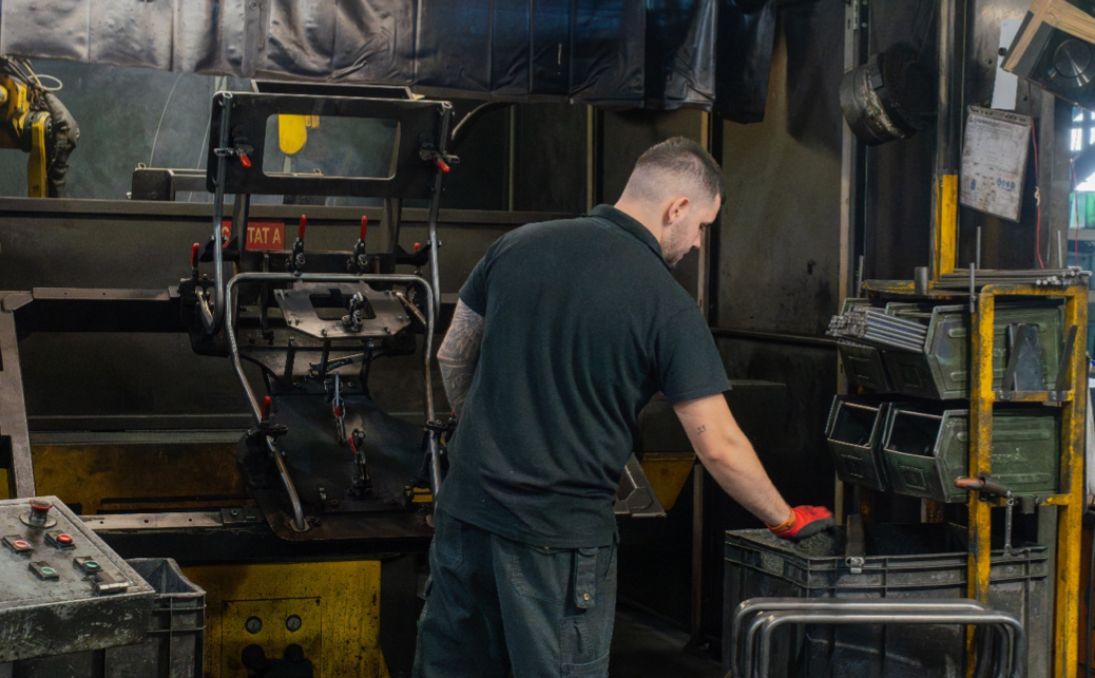
The image displays a bustling industrial environment where workers are handling already bent tubular structures that will become part of shopping carts. It clearly shows how the pieces move from the bending phase to subsequent stages such as assembly and welding, highlighting the importance of precision in each curve. In this context, the Bending tubes for shopping carts becomes a key process that conditions the resistance, ergonomics, and finish of the final product, especially in heavy-duty applications.
At COES, we work for industries, engineering firms, manufacturers, and distributors who need tubular parts with stable geometries and consistent tolerances. In shopping cart manufacturing, bending is not an isolated step; it's part of a chain that includes design, forming, welding, and dimensional control to obtain reliable assemblies ready for integration into production.
Why is the curve decisive in shopping carts
A shopping cart may seem like a simple structure, but it brings together multiple mechanical and functional requirements. The frame, handle, reinforcements, side frames, and other tubular parts must fit precisely to ensure stability and a comfortable user experience. Poor bending can lead to misalignments, internal stresses, ovalization, or more complex joints in later stages.
Geometry that conditions the entire set
Each radius of curvature influences the final shape of the car and how loads are distributed during use. When the geometry is replicated exactly, assembly is smoother and the structure maintains homogeneous behavior in short, medium, or long runs.
Ergonomics, aesthetics, and durability
In addition to its structural function, the curved tube provides visual continuity and improves the ergonomics of elements such as the handlebars or perimeter reinforcements. A well-executed curve reduces critical points, promotes a cleaner finish, and contributes to greater product durability.
Parts that typically require tube bending for shopping carts include:
Not all tubular parts have the same complexity, but many depend on exact radii and repetitions to ensure their integration into the final assembly. Among the most common components are:
- Backstage, base, and structural frameworks;
- wings and thrust zones;
- lateral reinforcements and crossbars;
- Auxiliary supports and metallic subsets;
- special elements for compact or high-capacity versions.
In these cases, the combination between tube bending, conformed y welding allows progress from the unit piece to the assembly-ready subassembly. Additionally, organizations like ISO they establish general quality frameworks that indirectly influence industrial processes, although each manufacturer applies its own project-specific standards.
Technical factors that determine a good outcome
In industrial manufacturing, creating a curve isn't just about bending a tube. The outcome depends on technical variables that affect the part's performance and the project's final cost.
Material, diameter, and thickness
The tube's behavior changes according to the material, outer diameter, wall thickness, and requested radius. Properly adjusting these parameters helps minimize deformations, wrinkles, or section losses, especially when working with references that must repeat the same shape in large volumes.
Tolerances and repeatability
In products like shopping carts, repeatability is fundamental. A small variation in an angle or a length can affect welding, tooling assembly, or overall alignment. That's why it's key to work with processes that ensure consistency between parts and batches.
Integration with downstream processes
Bending should be considered alongside the rest of the production process. A part that is well designed for bending also facilitates subsequent operations such as punching, cutting, assembly, or welding. This approach avoids rework and improves overall efficiency.
From Design to Production: A Complete Industrial Overview
When a car manufacturer looks for a supplier, they don't just need the right curve; they need a complete industrial solution. That's where expertise makes the difference. With over 40 years of experience, COES approaches projects with a practical vision: studying the geometry, validating manufacturing feasibility, and adapting the process to the client's needs.
This approach is especially valuable for national and international industries working with tight deadlines, custom specifications, or design changes. The ability to produce tailored solutions, combined with state-of-the-art technology and flexibility in materials and diameters, helps respond agilely to both new developments and recurring supply programs.
If your company needs tubular parts for demanding metal structures, you can learn more about our service of Company and production capacity to request a technical assessment directly from contact.
Advantages of having a bending and forming specialist
Working with a specialist brings value beyond the bending operation. In sectors where every millimeter counts in assembly, technical collaboration reduces incidents and improves the competitiveness of the final product.
- Greater technical precision curves consistent with the design and ready for integration into production.
- Fewer assembly deviations: best fit between parts, tooling, and welds.
- Process Optimization fewer reworkings and more efficiency in industrial series.
- Custom adaptation Solution aligned with functional, aesthetic, and logistical requirements.
For manufacturers and technical offices, this means having an industrial partner capable of assisting from the piece definition to the final structure. If you are evaluating a new project, visit our service at cold tube bending and review which options might fit with your application.
COES helps in projects for cars and other tubular structures by providing expertise in design, engineering, simulation, and manufacturing processes for these components. This can include optimizing the structural integrity of car frames, ensuring the strength and durability of scaffolding or bridge supports, and developing efficient production methods for various tubular elements.
At COES, we work with a results-oriented vision: precision, reliability, and customer adaptation. For applications such as shopping carts, display racks, mobility structures, or metal subassemblies, the objective is the same: to transform the tube into a functional, repeatable part ready for seamless integration into the manufacturer's process.
From Terrassa (Barcelona), we support B2B projects that require consistent quality, customized solutions, and responsiveness. When bending is planned correctly from the start, the final assembly gains strength, stability, and manufacturing efficiency. And that makes a real difference in products for intensive use.
If you're looking for a provider with industrial experience, check out our services: tube forming, welding or requests information via our contact form.
Frequently Asked Questions about Shopping Cart Tube Bending
Precision in tube bending for shopping carts is crucial for several reasons: 1. **Structural integrity and durability**: Properly bent tubes ensure the cart's frame is strong and can withstand the weight of groceries and repeated use. Inaccurate bends can create weak points, leading to premature failure and damage. 2. **Functionality and ease of use**: Precise bending allows for the correct assembly of all cart components, including the basket, handle, and wheels. This ensures the cart rolls smoothly, is easy to maneuver, and the basket holds its shape without collapsing. 3. **Safety**: A well-constructed cart, achieved through precise bending, is safer for shoppers and staff. It reduces the risk of the cart tipping over, unstable movement, or sharp edges protruding due to misaligned components. 4. **Aesthetics and brand image**: Accurate bending contributes to a uniform and professional appearance of the shopping carts. This reflects positively on the store's overall image and commitment to quality. 5. **Efficiency in manufacturing**: Precise bending means fewer errors and less rework during the manufacturing process. This saves time, reduces material waste, and ultimately lowers production costs. 6. **Standardization and compatibility**: Accurate bends ensure that all carts are manufactured to consistent specifications, making them interchangeable and easily repairable with standard parts. This is important for large retail operations that rely on uniformity.
Because each curved piece affects the overall assembly of the structure. If there are deviations in radii, angles, or lengths, problems such as misalignment, welding stresses, or difficulties in maintaining repeatability between units may arise. In a product subjected to intensive use and constant handling, precision not only improves assembly but also the stability, ergonomics, and lifespan of the cart.
What processes typically complement bending in this type of manufacturing?
It is customary to combine bending with forming, cutting, punching, assembly, and welding operations. The key is to understand the part as part of an industrial sequence and not as an isolated element. When the process is coordinated from the beginning, rework is reduced, and more efficient manufacturing is achieved, with better fit between subassemblies and a more coherent final structure.
Can custom parts be manufactured for different car models?
Yes, provided that the project is studied taking into account geometry, material, diameter, bending radius, and integration requirements. In B2B environments, it is common to work with product variants, compact formats, or specific developments for particular markets. Having a supplier with experience in tailor-made solutions makes it easier to adapt manufacturing without losing control over repeatability or industrial viability.
What value does a specialized provider bring compared to a simple bending operation?
A specialist is not limited to simply executing a curve. They bring technical judgment, knowledge of material behavior, process vision, and the ability to anticipate problems in later stages. This translates into fewer incidents during assembly, better overall quality, and more useful collaboration for engineering and manufacturing. In projects with industrial demands, this difference directly impacts timelines, costs, and reliability.
 Español
  English
  Català