
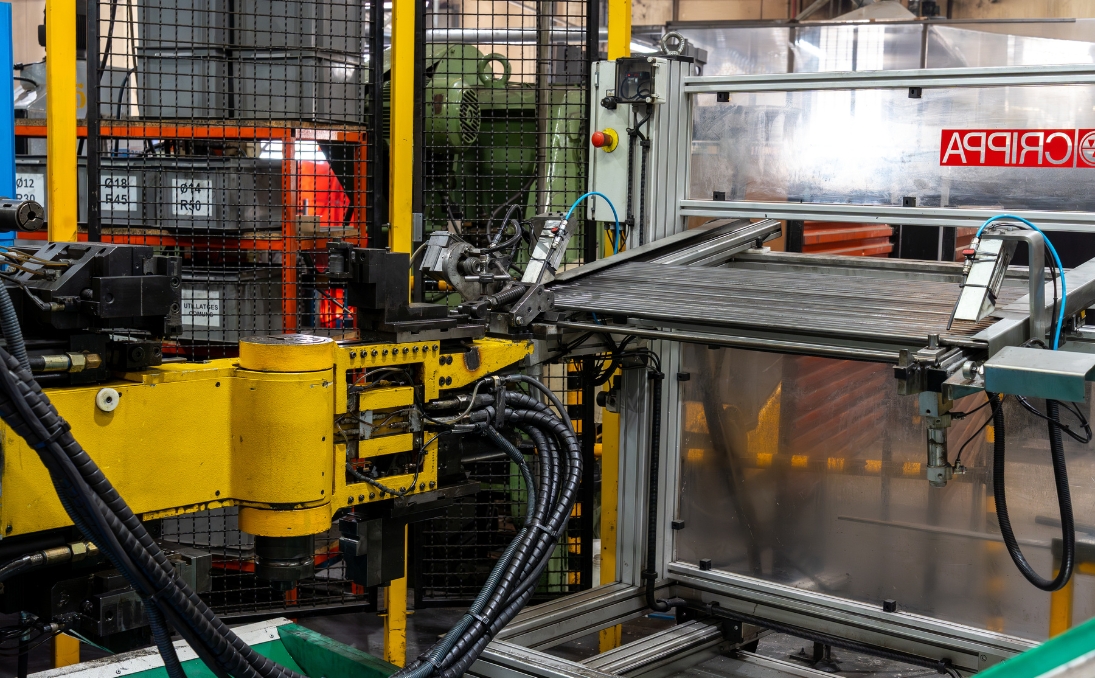
The image shows an automated industrial bending installation equipped with precision feeding and control systems, capable of manufacturing tubular components tailored for multiple applications. This type of technology represents the evolution of custom tube bending, a solution that allows you to meet the specific needs of each production sector with maximum efficiency and reliability.
At COES, from Terrassa (Barcelona), we develop custom projects for national and international clients who require unique pieces, short runs, or high-volume productions while maintaining high quality standards.
Custom tube bending involves shaping metal tubes into specific curves or angles according to precise specifications. This process is used to create components for various industries, including automotive, aerospace, furniture manufacturing, and medical equipment. Tube bending can be done using different methods, such as rotary draw bending, press bending, and roll bending, depending on the material, wall thickness, and desired bend radius.
Custom bending involves adapting each piece to the functional and technical requirements of the project. Factors such as material, diameter, thickness, bending radii, dimensional tolerances, and complementary processes necessary to obtain the final result are considered.
Far from being a standard solution, this approach allows for optimized integration of components in complex industrial systems and improved overall product performance.
Designs for every application
Each industry presents different constraints. Custom manufacturing facilitates specific solutions that reduce joints, simplify assembly, and improve the functionality of mechanical assemblies.
Cost reduction
Adaptation from the source prevents subsequent modifications, reduces installation times, and contributes to greater efficiency in the production chain.
Custom tube bending for key industrial sectors
The versatility of tube forming allows it to meet a wide range of needs within today's industrial landscape.
Automotive industry
Manufacturers in the sector require lightweight and durable components capable of meeting strict dimensional specifications. Exhaust systems, subframes, and technical piping rely on high-precision bending processes.
Industrial machinery manufacturing
Tubular structures are an essential part of numerous machines and production equipment. Customization allows for space optimization, strengthening mechanical resistance, and facilitating maintenance operations.
Climate control and fluid conveyance
HVAC systems and industrial facilities require tailored ductwork that improves energy efficiency and reduces pressure drop in fluid transport.
Metal furniture and commercial equipment
Custom bending offers new design possibilities, allowing for the creation of functional structures with high aesthetic quality and great durability.
Advanced technology to ensure maximum accuracy
Industrial automation has revolutionized bending processes, allowing for higher levels of repeatability and dimensional control even in complex production.
According to the technical information of the specialty magazine The Fabricator, the integration of automated systems and digital simulations is transforming the manufacturing of tubular components, increasing productivity and reducing error margins in the metallurgical industry.
Tolerance and Quality Control
Geometric precision is essential to ensure the correct integration of each component in the final assembly and to avoid issues during production.
Adaptation to multiple materials
Carbon steel, stainless steel, and aluminum are some of the most used materials, although each project requires an analysis of the most suitable mechanical and functional properties.
You can learn more about our capabilities at industrial tube bending and in our processes of tube forming.
Benefits of custom tube bending versus conventional solutions
Custom manufacturing provides competitive advantages that directly impact the operational efficiency of companies.
- Optimizing the design and utilization of available space.
- Reduction of welds and additional joining elements.
- Reduced assembly times.
- Better aesthetic and functional quality of the final product.
- Full adaptation to specific technical requirements.
- Improved productivity and reduced overhead costs.
These advantages explain the growing interest in customized solutions in increasingly specialized and demanding sectors.
The importance of having a specialized industrial partner
A project's success doesn't depend solely on the available machinery. Technical expertise and advisory capacity are equally crucial for obtaining reliable and competitive components.
Engineering and collaboration from the initial phases
Participating in the design development allows for optimizing geometries, reducing production costs, and improving the industrial feasibility of each part.
The future of custom tube bending
The integration between digital design, automation, and intelligent control will continue to drive increasingly efficient and sustainable solutions. Companies that incorporate customized processes will be better prepared to face the competitiveness and differentiation challenges required by today's industry.
If you need to develop components tailored to specific production or design requirements, we invite you to visit our service of industrial welding to contact directly through our contact page.
Custom Tube Bending FAQ
What industries commonly use custom tube bending?
Automotive, industrial machinery, air conditioning, urban equipment, metal furniture, and fluid conveyance systems are some of the sectors that most frequently use custom solutions to optimize their products and production processes.
What materials can be industrially curved?
The most common materials are carbon steel, stainless steel, and aluminum, although the choice depends on the mechanical, environmental, and functional requirements of each specific application.
Is it possible to manufacture prototypes before mass production?
Yes, but always as part of the mass production project. Prototyping allows for the validation of dimensions, geometries, and production processes before starting large manufacturing volumes, reducing risks and optimizing costs.
Why is preliminary technical advice important?
Proper collaboration from the early stages of the project facilitates design optimization, improves industrial efficiency, and allows for the production of more competitive and durable long-term components.
 Español
  English
  Català